
A thread gauge checks the metal thread. It does not show whether an insert will stay in its host component when the screw is tightened. Before approving a threaded insert assembly, separate three responsibilities: the loose insert, the receiving hole and the installation process. An RFQ that names only the insert leaves two of those interfaces undefined.
This is a drawing and acceptance review from Zhengna Technology, not a test report or an installation specification for the pictured part.
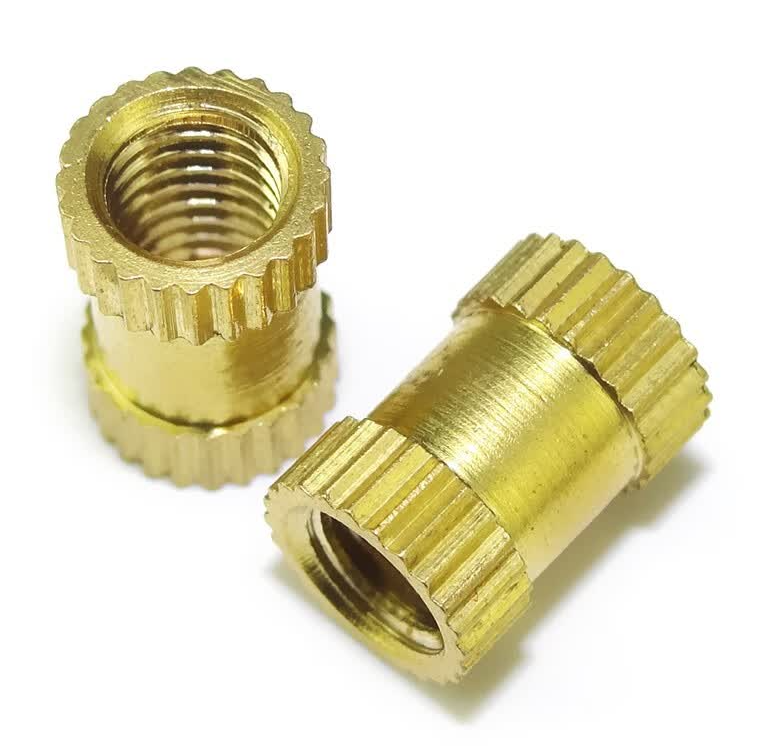
These real brass threaded insert examples show the interface that needs defining. Their exact alloy, installation method, host material and strength have not been established. Do not select an installation process from the appearance of the knurl.
Put the insert drawing, host-component drawing and assembly instruction beside one another. Each should identify a revision and an approval owner. If one supplier quotes only the metal part and another installs it, the handover must say who resolves a mismatch before either operation is released.
For plastic hosts, SPIROL identifies several installation families and treats insert design, plastic composition, hole geometry and installation as related variables. Its threaded-insert guidance is useful for selecting a review route, not for assigning a process or rating to an unqualified custom sample.
If heat or ultrasonic installation in plastic is selected, the receiving hole must suit that insert and material. SPIROL warns that oversized holes can reduce retention while undersized holes can introduce stress or cracking; screw bottoming and mating-part clearance also need attention. Consult its hole-design guidance for heat/ultrasonic inserts within that stated scope. Do not transplant a catalog hole dimension to a different insert, polymer or process.
In the assembly review, show where the screw is intended to stop and which faces should seat first. Record the installed position independently of thread engagement. A screw reaching an internal stop is not evidence that the intended joint faces have clamped together.
The loose-part record should identify the part and revision, the thread requirement, the measured external features and the delivered surface condition. A passing record answers whether the supplied insert meets those requirements.
The assembly record asks a different question. Identify the host revision and material, installation instruction, sample identity, seated-position check and any specified functional test. If torque-out or axial pull-out is required, agree the loading method, fixture, acceptance criterion and responsible reviewer before testing. Do not replace that agreement with an unspecified claim of high strength.
When a loose insert passes its drawing but an installed joint fails, retain both records rather than calling the metal part accepted for every purpose. Review the receiving component and installation evidence alongside the insert. Conversely, one successful assembly is not a substitute for checking the ordered insert characteristics or establishing a production acceptance plan.
For quotation, send the precision insert part definition and describe whether the request covers metal parts only or an additional operation to be reviewed. See the CNC machining commercial scope, then contact Zhengna Technology with the controlled revisions, quantity and open responsibility questions. No assembly test, installation capability or delivery commitment is implied by this guide.

 EN