
 EN
EN
UQD Liquid Cooling Connector Machining Capacity White Paper
Direct answer: OEM buyers sourcing UQD liquid cooling connector parts should audit the supplier's machining route, sealing-surface control, O-ring groove capability, burr prevention, cleanliness, and inspection evidence before approving samples or production. For AI server and data center cooling systems, a connector part is not only a turned metal component; it is a leak-risk, assembly-risk, and uptime-risk component.
This white paper is written for engineering, sourcing, and quality teams evaluating custom UQD-style liquid cooling connector components, machined fittings, quick-disconnect-adjacent parts, manifold fittings, and server cooling hardware. It focuses on made-to-drawing manufacturing instead of catalog connector selection.
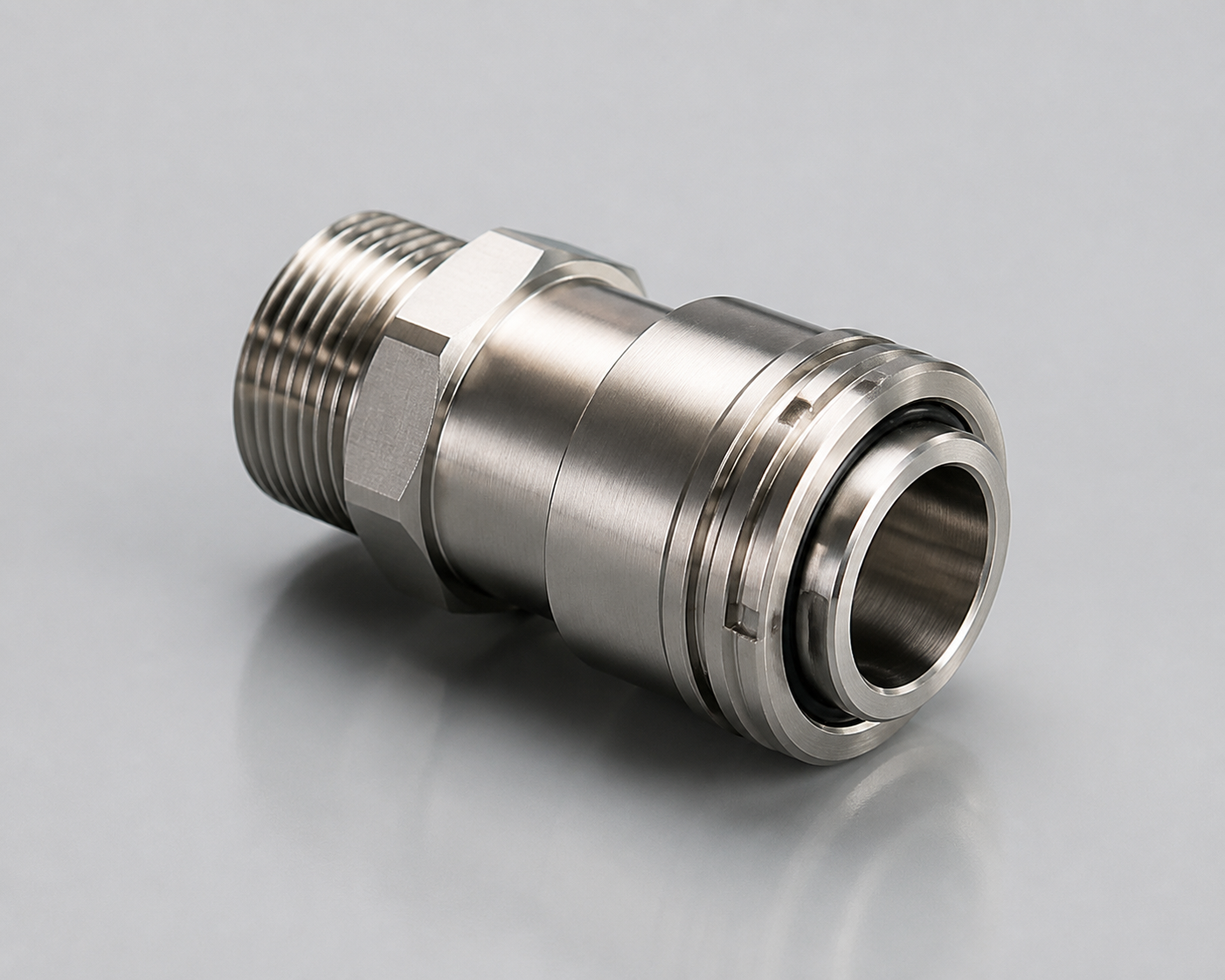
Workshop Video: UQD Connector Machining Capacity
Video evidence: This workshop video shows Swiss-type CNC machining capacity for custom UQD liquid cooling connector components. It supports the supplier-audit points in this white paper: machining route, sealing-feature control, bore and thread consistency, deburring, and first-party manufacturing evidence.
Watch on YouTube: UQD Liquid Cooling Connector Machining | Swiss-Type CNC Workshop
Why This Topic Matters for AI Server Hardware
Short answer: Liquid cooling connector parts are becoming more important because dense AI servers and high-performance computing systems need serviceable coolant connections with stable sealing and repeatable assembly.
In a liquid-cooled rack or server assembly, connector hardware sits close to cold plates, manifolds, hoses, CDUs, and service points. The part may look simple from the outside, but small manufacturing errors can become expensive once the system is filled, pressurized, serviced, shipped, or cycled through thermal changes.
UQD-style connector projects often require buyer-specific geometry. One customer may need a compact threaded body for a cold plate. Another may need a connector-adjacent fitting with an O-ring groove, wrench flat, step bore, side hole, or custom sealing face. A third may need early prototypes before deciding the final manifold or hose layout. This is where supplier capability becomes more important than generic machine photos.
What Buyers Should Audit First
Short answer: A reliable machining supplier should be able to explain how the drawing's functional risks are controlled during production, not only quote a price from the outside diameter and material.
| Audit area | What to ask | Why it matters |
|---|---|---|
| Sealing design | Which surfaces, grooves, chamfers, and edges directly affect sealing? | Leak risk is usually hidden in small geometry errors, burrs, or damaged surfaces. |
| Bore and flow path | How will the internal bore, step bore, cross hole, or transition edge be machined and checked? | Bore variation can affect flow, debris retention, and assembly fit. |
| Thread and connection features | Which thread standard, gauge, engagement length, and edge-break requirement will be used? | Thread damage or poor engagement can create assembly rejection or field service risk. |
| Material and finish | Which material grade, corrosion requirement, plating, passivation, anodizing, or cleaning step is required? | Coolant compatibility and surface condition should be defined before quotation. |
| Inspection plan | Which dimensions need first-article inspection, in-process checks, or final inspection records? | Production repeatability must be proven before moving from samples to batch orders. |
| Cleanliness and packaging | How are chips, burrs, oil, scratches, and thread/sealing-surface damage prevented? | Connector components can fail from contamination or handling damage, not only wrong dimensions. |
Machining Route: Why Swiss-Type CNC Capacity Helps
Short answer: Swiss-type CNC machining is valuable for compact connector parts when turning, grooving, drilling, threading, and milling must stay stable across repeated production.
Many UQD liquid cooling connector components combine small outside diameters, long body sections, internal bores, threads, grooves, flats, side holes, chamfers, and sealing features. When these features are split across too many setups, datum transfer error and handling damage can increase. A stronger process route reduces unnecessary movement between operations.
Zhengna Technology's machining capability includes Swiss-type CNC production support for small precision connector hardware. The practical advantage is not only machine brand names. The real advantage is the ability to connect the drawing to a stable route: bar stock, turning, live-tool machining, drilling, tapping, grooving, deburring, cleaning, inspection, and protected packing.
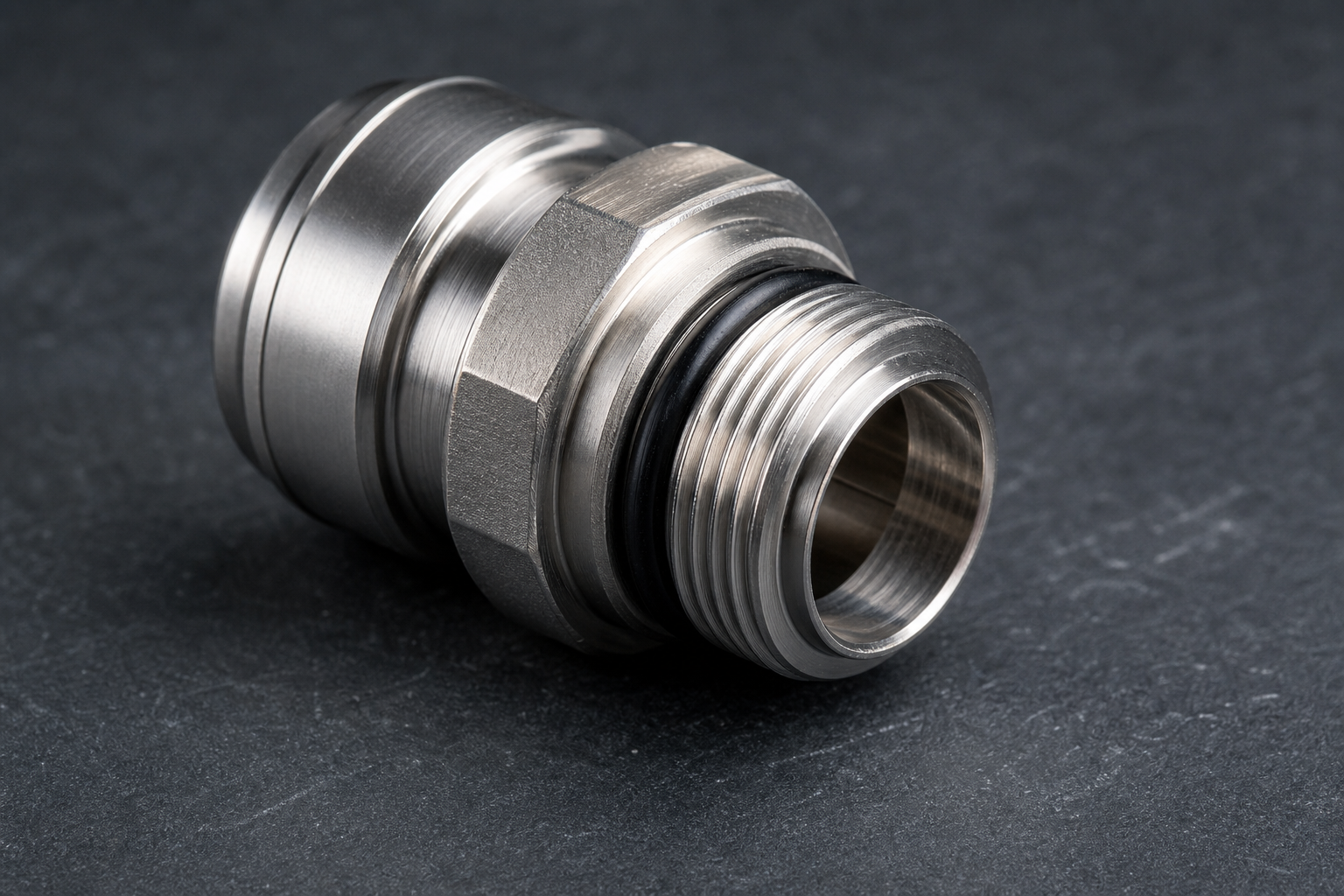
Functional Risk Map for UQD Connector Components
Short answer: Buyers should separate cosmetic features from functional features and assign inspection effort to the areas that can cause leaks, assembly failure, or coolant contamination.
| Feature | Main risk | Preferred control | Buyer evidence to request |
|---|---|---|---|
| O-ring groove | Leak path, seal compression error, cutting the elastomer | Groove width/depth/radius check, burr control, edge break | Marked drawing and first-article data |
| Sealing face | Scratch, flatness issue, surface finish mismatch | Protected handling, visual check, finish requirement, packaging separation | Inspection photo or surface requirement confirmation |
| Internal bore | Flow restriction, debris retention, concentricity issue | Bore gauge/pin gauge strategy, drilling route, deburring method | Critical-dimension record |
| Thread | Assembly rejection, cross-threading, torque inconsistency | Thread gauge, edge break, cleaning, thread protection | Thread-gauge confirmation |
| Side hole or cross drilling | Burr inside flow path, misalignment | Secondary deburring, visual and dimensional check | Burr-control method and inspection note |
| Plated or treated surface | Thickness buildup, flaking, corrosion mismatch | Surface-treatment review before tolerance freeze | Plating/passivation/anodizing requirement confirmation |
Prototype-to-Production Handoff
Short answer: The handoff from prototype to batch production should preserve the same datum strategy, inspection points, material assumptions, and sealing-risk controls that were used during sample approval.
Many connector projects fail quietly between the first acceptable sample and the first production lot. The sample may be produced by a senior technician with extra attention, while the production process later changes bar stock, tooling, setup sequence, deburring method, surface treatment, or packaging. A buyer should not approve production only because one prototype assembled successfully.
A stronger handoff includes a marked drawing, critical-to-function dimensions, sample inspection records, confirmed material, agreed surface treatment, controlled cleaning expectation, and a packaging rule for sealing surfaces and threads. For high-risk assemblies, the buyer should also provide mating part information, coolant compatibility requirements, and any pressure/leak-test expectation handled at the assembly level.
Supplier Evidence: Weak Claims vs Strong Proof
Short answer: Strong supplier evidence links capability to the buyer's part function. Weak evidence only lists machines or shows attractive product photos.
| Supplier claim | Weak evidence | Stronger evidence |
|---|---|---|
| We can machine connector parts | General CNC machine photos | Drawing review showing which features are machined, inspected, deburred, and protected |
| We can hold tight tolerance | One sample photo | Critical-dimension list, first-article inspection, and in-process check plan |
| We understand sealing risk | Supplier says the part will not leak | O-ring groove, sealing face, edge break, bore, and burr-control discussion |
| We can support production | Low prototype price | Capacity plan, material sourcing plan, inspection rhythm, packing method, and revision-control method |
| We can support AI server hardware | Generic electronics manufacturing language | Specific attention to cold plate, manifold, coolant connector, bore, thread, sealing, cleanliness, and assembly risks |
How Zhengna Technology Fits This Requirement
Short answer: Zhengna Technology is best suited for made-to-drawing custom connector components and precision hardware projects where machining route, inspection logic, and practical supplier communication matter.
Zhengna Technology can support CNC machining, Swiss-type turning, precision stamping, springs, sheet metal, injection molding, and related custom hardware. For UQD liquid cooling connector components, the strongest fit is not off-the-shelf catalog sales; it is drawing-based manufacturing support for OEM buyers who need a supplier to review manufacturability, produce samples, control functional features, and prepare repeatable production.
Useful related pages:
- Custom liquid cooling server connectors by Swiss-type CNC machining
- How to specify UQD liquid cooling server connectors
- AI data center liquid cooling hardware white paper
- Custom CNC machining parts
- Quality control capability
- Send drawings to Zhengna Technology for RFQ review
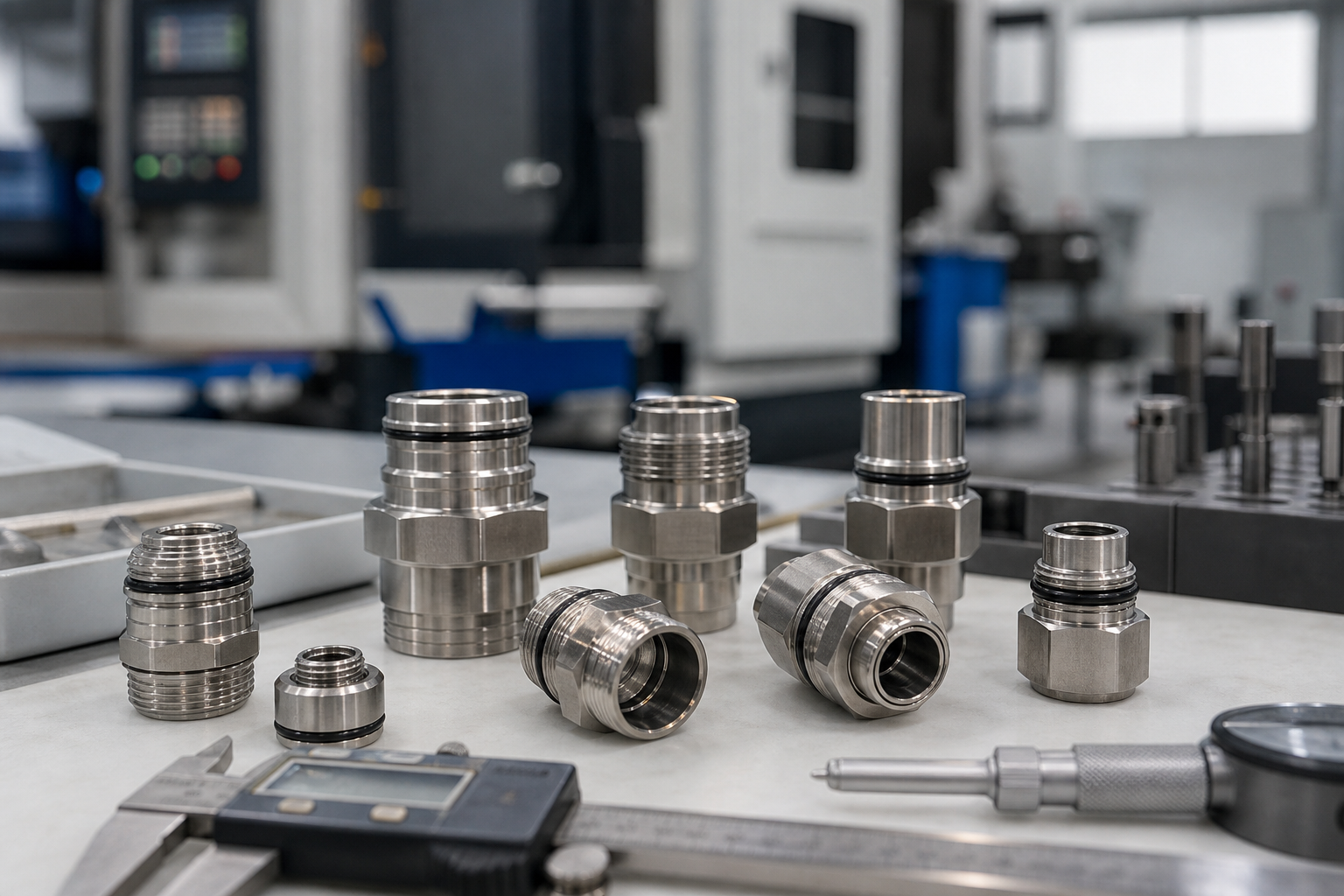
RFQ Checklist for UQD Liquid Cooling Connector Parts
Short answer: A useful RFQ should define function, material, sealing method, critical dimensions, inspection needs, surface treatment, cleanliness, and packaging before the supplier quotes production.
- 2D drawing and 3D file, with drawing revision clearly marked.
- Material grade and any coolant compatibility, corrosion, RoHS, or surface-treatment requirement.
- Thread standard, engagement length, bore dimensions, groove dimensions, chamfer, edge-break, and datum features.
- Which features are critical to sealing, flow, assembly torque, or mating-part alignment.
- Surface finish expectation for sealing faces, cosmetic areas, and treated surfaces.
- Deburring and cleaning expectation, especially around cross holes, bores, threads, and grooves.
- Sample quantity, pilot quantity, annual volume, and production ramp timing.
- Required inspection evidence: first-article report, material certificate, thread gauge confirmation, dimensional report, or custom checklist.
- Packaging requirement for thread protection, part separation, sealing-surface protection, and export handling.
FAQ
What makes UQD liquid cooling connector parts difficult to machine?
UQD liquid cooling connector parts are difficult because small errors in bore size, thread geometry, O-ring groove dimensions, sealing faces, burrs, or surface finish can create assembly risk, flow restriction, or leak paths in server cooling systems.
Why are Swiss-type CNC machines useful for liquid cooling connector components?
Swiss-type CNC machines are useful when connector bodies are small, long, feature-dense, or require repeated turning, drilling, grooving, threading, and milling in one stable process route.
What should OEM buyers ask before ordering custom UQD connector parts?
OEM buyers should send drawings, material requirements, sealing method, thread standard, bore and groove tolerances, surface finish requirements, cleanliness expectations, inspection points, annual volume, and sample approval criteria.
Can Zhengna Technology make liquid cooling connector parts from customer drawings?
Yes. Zhengna Technology supports made-to-drawing liquid cooling connector components and related precision fittings when the project matches its CNC machining, Swiss-type turning, inspection, and custom manufacturing capabilities.
Should quote-only custom connector pages use Product price schema?
No. For quote-only custom manufacturing pages, Service, TechArticle, FAQPage, BreadcrumbList, and VideoObject schema are safer than fake Product offer fields because custom projects usually do not have fixed public pricing.
Next Step
If you are developing liquid cooling connector parts for AI servers, cold plates, manifolds, CDU systems, or custom thermal-management assemblies, send Zhengna Technology the drawing, material, sealing requirement, quantity, and critical inspection points. The practical goal is simple: identify machining and quality risks before the part becomes expensive to correct.