
 EN
EN

Role: authority/decision guide. This page helps engineering, sourcing and supplier-quality teams define spring operating points before quotation. It does not select a universal spring type, material, spring rate, tolerance or life requirement, and it does not replace a released drawing or project acceptance plan.
Custom Spring Load, Working Height and Rate RFQ Guide
“Make this spring stronger” is not a controlled requirement. A quote-ready spring package connects the spring function to a reference geometry, one or more load-position points, the installed or preloaded state, usable travel, environmental conditions, cycle expectation and the evidence needed for release.
The right inputs depend on spring type. A compression spring is commonly described by force at a specified height. An extension spring may require initial tension plus load at a stated length. A torsion spring needs moment at a defined angular position and a clear leg orientation. Treating all three as a single “spring rate” problem can hide the operating condition that actually controls fit and performance.
Use this guide with the custom springs commercial page from Zhengna Technology. Review the inspection context on the quality-control page, then use the contact page to arrange controlled drawing and requirement transfer.
Begin with the spring's job in the assembly
State what the spring must do: return a mechanism, maintain contact, store energy, resist motion, hold a component, absorb variation or create a defined force or moment. Identify the mating features, direction of action and failure consequence. A load value without this context may describe the wrong assembly state.
Name the spring type only when it is already controlled. If the supplier is expected to propose a type, provide the available envelope, mounting interfaces, force or moment targets, movement, service condition and prohibited failure modes. That lets the design question remain open without turning the RFQ into guesswork.
Establish datums and the measurement state
Every operating point needs a reference. For a compression spring, define whether height is measured between ground ends, bearing faces, retainers or another assembly datum. For an extension spring, define whether length is measured over hooks, between hook centres or between controlled attachment points. For a torsion spring, identify the body reference, leg positions, winding direction and zero-angle convention.
Also define the spring state: free, installed, preloaded, actuated, thermally conditioned, cycled or otherwise prepared. Measurements taken before and after presetting, relaxation, ageing or a specified conditioning sequence are not automatically interchangeable. The drawing and inspection plan should use the same state.
Use operating points, not an isolated rate
When possible, give at least two controlled operating points. For a compression spring, that may be force F1 at height L1 and force F2 at height L2. For an extension spring, define load at specified lengths and state whether initial tension is part of the requirement. For a torsion spring, define moment M1 at angle A1 and M2 at angle A2 using the same angular datum and loading direction.
A calculated rate can help compare the slope between defined points, but it should not be treated as proof that behaviour is perfectly linear across the complete travel. End conditions, coil contact, initial tension, friction, geometry and the measurement setup can change the observed curve. If the mechanism depends on a full force-deflection or moment-angle curve, request the curve and define the controlled range rather than reducing it to one number.
| Spring condition | Controlled input | Typical ambiguity to remove |
|---|---|---|
| Compression | Force at specified height, free height reference and load direction | Whether height uses spring ends or assembly datums |
| Extension | Load at specified length, attachment geometry and initial-tension requirement | Whether length is over hooks, centre-to-centre or between fixtures |
| Torsion | Moment at specified angle, leg orientation, winding direction and zero reference | Which leg moves, viewed direction and angular datum |
| Complex or nonlinear response | Controlled curve, range, conditioning and sampling rule | Whether a nominal rate is being incorrectly applied to all travel |
Separate preload, working travel and limiting travel
Preload is an installed condition, not simply another free-state dimension. Define the installed height, length or angle and the expected force or moment at that condition. If the assembly tolerance changes preload, identify the range that must be reviewed rather than quoting only the nominal position.
Next define the normal working movement and the limiting position that may occur during assembly, adjustment, overload or service. For compression springs, identify the required clearance from coil contact or solid condition according to the project design. For extension and torsion springs, define permissible movement without assuming that hook, leg or body stress is acceptable at every geometric limit. The buyer remains responsible for communicating the actual mechanism envelope and safety consequence.
Connect geometry to the operating points
Provide a controlled 2D drawing and, where useful, a 3D model. State which file governs if they disagree. Define the spring body, wire or strip section, end or leg geometry, attachment features, orientation, keep-out zones and critical interfaces. Mark dimensions that affect assembly separately from reference dimensions.
Do not lock a material, treatment or finish only because it appeared on an old drawing if the service condition has changed. Conversely, do not invite substitution when compatibility, conductivity, cleanliness, temperature, corrosion, magnetic behaviour or regulatory constraints make the approved material route essential. State who has design authority and how an alternative is reviewed.
Define environment and life as testable conditions
Describe temperature, moisture, corrosion exposure, chemicals, debris, cleaning, electrical or magnetic constraints and contact with mating materials where relevant. State whether operation is static, occasional or cyclic, the expected movement range, target cycles and consequence of loss of force, set, fracture or attachment failure.
A cycle target alone is incomplete. A fatigue or relaxation evaluation needs the operating points, mean and alternating condition, rate or dwell where relevant, temperature, mounting and acceptance rule. Do not infer life from a workshop image, a material name or one room-temperature load check.
The spring supplier audit and fatigue-control guide explains how to structure that separate evidence question. Its role is not to promise a life result before the project inputs and validation plan are controlled.
Agree how load or moment will be measured
Define the fixture, alignment, contact surfaces, loading direction, instrument capability, approach direction, dwell, speed or sequence when those conditions affect the reading. State the measurement point, allowed tolerance, sampling plan, data-record requirement and treatment of rounding. A tester display without the correct datum and spring state is not enough.
Where two operating points matter, agree whether both are individually accepted, whether a calculated rate is also reported, and how the rate is calculated. Where the curve is nonlinear, use the agreed curve band or defined point set instead of forcing a misleading single-rate tolerance.
Plan prototype, first-article and lot release evidence
Separate design learning from production release. A prototype may confirm envelope and mechanism response without representing the final material, tooling, treatment or production process. A first article should identify the controlled revision, material route, key geometry, operating-point results and any approved deviation. Lot release should state the sample size, frequency, records and traceability expected for the actual supply program.
If destructive or cycle testing is required, define the test quantity, disposition and whether tested pieces may ship. If capability evidence is requested, define the characteristic, sample basis and process state rather than asking for a generic capability report.
Custom spring RFQ checklist
- Spring function, mechanism, action direction and failure consequence.
- Spring type or the envelope and interfaces for a supplier proposal.
- Controlled drawing/model revision and governing-file rule.
- Reference datums, free state, installed state and conditioning state.
- At least one, preferably two, force-position or moment-angle points.
- Preload, normal working travel and limiting assembly or service position.
- Critical geometry, end/hook/leg form, orientation and mating features.
- Material, treatment and finish authority plus environmental constraints.
- Cycle or relaxation condition, target, test method and acceptance owner.
- Measurement setup, tolerances, sampling, records and traceability.
- Prototype, first-article, annual and batch quantities plus delivery destination.
Where Zhengna Technology fits
Zhengna Technology reviews made-to-drawing spring projects around controlled files, spring geometry, material and finish scope, operating points, inspection expectations, quantity and delivery requirements. The final spring type, material, load, rate, tolerance, process route, fatigue validation, MOQ and lead time remain project-specific until the technical package and supply scope are reviewed.
Start with the custom springs service for commercial context and use the contact route to identify the part, revision, operating points, quantity and required evidence before controlled file transfer.
Frequently asked questions
Is a target spring rate enough for quotation?
Usually not. Add the spring type, datums, free or installed state, load-position or moment-angle points, working travel, geometry, environment and acceptance method. A rate without its controlled range can describe the wrong operating condition.
Why provide two load points?
Two points show the required response across a defined interval and make the intended rate calculation traceable. They also reduce ambiguity about preload and the relevant working range.
How should an extension spring be specified?
Define attachment geometry, the length datum, initial-tension requirement where applicable, loads at stated lengths, working and limiting extension, material/finish authority and the measurement setup.
How should a torsion spring angle be defined?
Identify the viewing direction, winding direction, fixed and moving legs, zero-angle reference, moment at controlled angles and the installed orientation. A drawing view without those conventions can reverse the intended action.
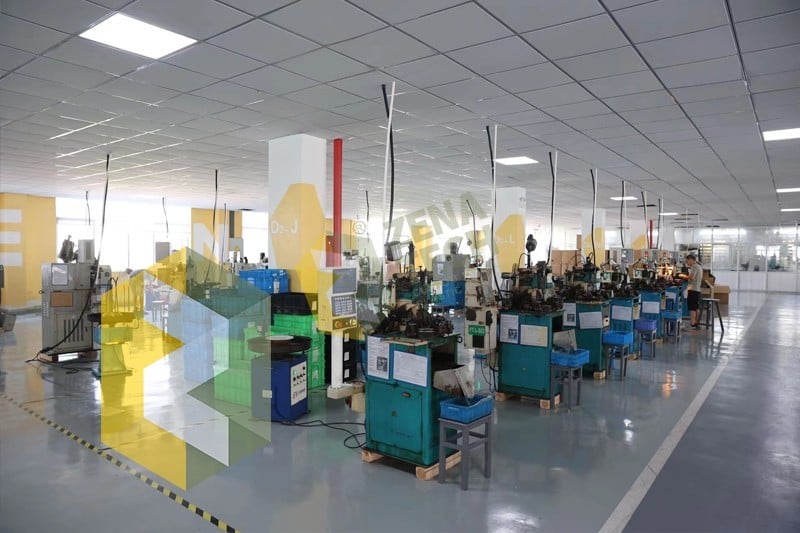
Does a representative workshop image prove spring performance?
No. It can show visible process context only. It cannot establish project material, dimensions, load, rate, fatigue life, treatment, inspection result or approval.
Sources and review boundary
Reviewed on 2026-08-10 by Zhengna Technology. These sources support common spring terminology and technical-product-documentation or ordering context only. They do not establish Zhengna Technology certification, a universal design rule or a completed project result.