
 EN

Retaining Clip Fit: Panel Engagement and Removal Access
A retaining clip drawing needs an installed condition as well as a loose-part shape. Before requesting a quote, identify what locates the clip, what resists withdrawal and how the connection will be removed if service is required. A photograph of a clip cannot answer those three questions for the mating assembly.
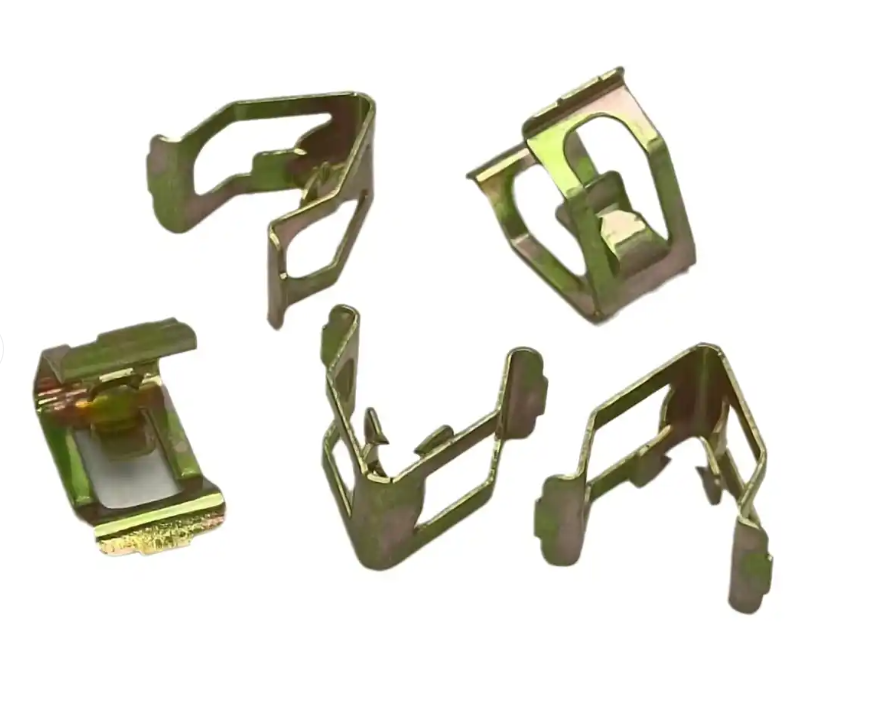
This review uses actual Zhengna Technology automotive ticket-box fixing clip examples to explain the information handoff. It does not assign dimensions, a material grade, a coating or a force rating to the photographed parts. Product examples and the drawing-led quotation path are on the custom metal clips page .
Mark the two sides of the connection
Initia cum sectione vel assemblage detail quae cistulam, tabulam aut brachium ostendit quod clippum recipit. Nominare faciem localisantem et faciem retinentem separatim. Dimensio quae positionem clippi laxi definit non semper clearance ad componentem retentum regit; igitur relationem quae in positione assemblata maxime valet notare oportet.
Etiam ostendere directionem insertionis. Tabula curvata quae ante assemblationem accessibilis est post aliam tabulam aptatam celari potest. Si installatio ex una parte tantum dependet, hanc restrictionem in RFQ includere oportet, non autem e photographia producti a suppeditatore inferri relinquere.
| Detail interfaciei | Informationes quae in descripto controlato ponendae sunt | Quaestio quam solvit |
|---|---|---|
| Spissitudo coniungens vel apertura | Limites, loca contactus, conditio marginis et status finis relevans | Quam conditionem clippus formatum accommodare debet? |
| Positio sedens | Facies localisans, positio obstaculi, spatium liberum et motus permittendus | What distinguishes fully installed from partly engaged? |
| Retention feature | Contacting feature and direction of the specified withdrawal check | Which interface is intended to resist removal? |
| Service Access | Accessible side, tool space and replace-versus-reuse requirement | Can the connection be released without an unintended operation? |
Review the limiting assembly conditions
Do not quote only a nominal panel thickness and assume it represents the whole fit. Ask the design owner to identify the smallest and largest relevant mating conditions, including any specified finish or edge condition. Then agree which assembly conditions will be used for sample evaluation. The required values belong to the project drawing; this page supplies no universal panel range.
Keep location and retention as separate acceptance questions. A clip may reach its intended position without proving the specified withdrawal behaviour. Equally, a connection that resists removal does not by itself prove acceptable installation effort or serviceability. If those characteristics matter, give each a defined method and acceptance condition.
Decide what a functional check would actually prove
A request such as “check the spring force” leaves important choices open. Specify whether the requirement concerns insertion, withdrawal or another direction; the mating component or fixture; the installed position; and the acceptance rule. Identify the sample condition and whether the check is developmental, first-article or production-lot acceptance. Zhengna Technology must confirm the proposed scope before it becomes a quotation commitment.
Corrosion, vibration, repeated removal and finished-assembly performance are separate requirements. Do not substitute a dimensional report for a functional result, or a coating name for a corrosion report. A test claim needs its own specimen identity, method, conditions and acceptance record. None of those results is established by the examples shown here.
Set the removal responsibility before tooling review
If the connection will be serviced, show the release sequence and the available tool envelope in the assembled product. State whether the clip, the mating part or both are replaced after removal. Do not assume that a part can be reused because it can be removed once; reuse is a design and acceptance requirement that must be reviewed separately.
For a connection intended to stay assembled, identify that requirement just as clearly. The supplier should not add a release feature or change an engagement detail based on an unstated expectation. Resolve the interface with the design owner before using the photograph as a sourcing reference.
Send one consistent quotation package
Use the same revision for the clip drawing and the mating detail. Include the installation direction, seated condition, material and finish authority, critical characteristics and any proposed functional evaluation. Separate the loose-part supply scope from assembly and system-validation responsibilities. State requested quantity and timing as RFQ inputs, not assumptions about published MOQ or delivery.
Recensere actual metal clip product examples alongside the capacitas partium sigillatarum ad usus speciales . The pagina de controllo qualitatis explains drawing-dependent inspection planning. Contact Zhengna Technology with the revision and interface requirements to start the scope review.
Editus a Technologia Zhengna. Directivum generale pro examinando schemate separatim est ab evidentiis de parte particulari, resultato experimenti, aut approbatione aggregationis finitae. Nulla recensio ab experto nominato, nulla tolerantia universalis, nulla aestimatio fortitudinis, nulla praestatio strati, nec ullum terminus commercialis asseritur.